

The question comes up every time someone considers a trip to Jaisalmer: is it actually safe to travel near the India-Pakistan border?
It is a fair question. The border is real, the military presence is visible, and the history of the region — particularly the 1971 war — is not distant. But the answer, for most travelers, is yes. The border region near Jaisalmer has been open to tourism for decades, is under constant and professional military oversight, and draws hundreds of thousands of visitors each year without serious incident.
What matters is understanding where you can go, what the rules are, and how to prepare. This guide covers all of it.
Why Travelers Visit the Border Region
The Indo-Pak border near Jaisalmer is not a single line on a map — it is a landscape with history embedded in it. Two sites in particular draw the largest number of visitors:
Tanot Mata Temple sits roughly 120 km from Jaisalmer, deep in the Thar Desert near the border. During the 1971 war, the temple and its surrounding area reportedly survived intense shelling with minimal damage — an event that has made it a site of both religious significance and national pride. The temple is now maintained by the Border Security Force (BSF), which also manages the small war museum on the premises.
Longewala War Memorial marks the site of the famous Battle of Longewala in December 1971, where a small Indian Army unit held off a far larger Pakistani armored force with air support. The memorial includes preserved Pakistani tanks, original bunkers, and a museum. It was immortalized in the 1997 Bollywood film Border.
Both sites are fully authorized for civilian visitors, regularly maintained, and patrolled. They offer something genuinely unusual — a front-row view of recent military history in a landscape that has barely changed since the war.
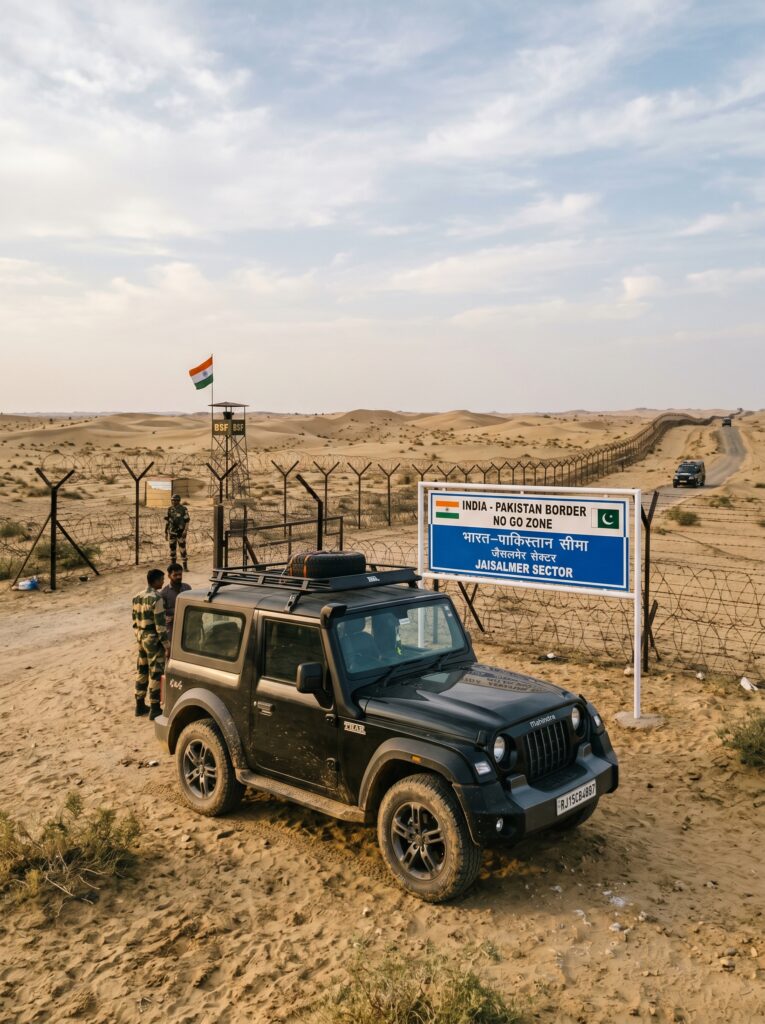
How Safe Is It, Practically Speaking?
The short answer: safe, within defined zones.
The Indian Army and BSF maintain a visible presence throughout the region, and this presence is exactly what makes tourism viable here. The roads to Tanot and Longewala are patrolled, checkpoints are operational, and the areas open to tourists are clearly separated from restricted military zones.
Local villages exist within a few kilometers of the border, and their residents live and work normally. The region has not seen civilian conflict in decades. For Indian citizens traveling with valid ID, the experience is straightforward. International tourists need to ensure their documents are in order and should check current permit requirements before travel, as these can change based on broader diplomatic conditions.
The one genuine variable is the broader India-Pakistan diplomatic climate. During periods of heightened tension, access to certain areas — particularly those very close to the border — may be temporarily restricted. It is worth checking current conditions before you travel, especially if you are visiting specifically for the border sites rather than Jaisalmer’s other attractions.
Rules You Must Follow
These are non-negotiable and exist for your safety and the security of the region:
Carry valid government-issued ID at all times. Indian nationals should carry an Aadhaar card or passport. Foreign nationals must carry their passport. ID checks at military checkpoints are routine and quick — just have your documents accessible.
No drone or aerial photography. This is strictly enforced near the border. Drones are prohibited, and violating this rule can result in confiscation of equipment and serious legal consequences. Ground photography at permitted sites is generally allowed.
Do not travel after dark in border-adjacent areas. Authorized tours operate during daylight hours. This is both a security requirement and a practical one — the desert roads are poorly lit and the terrain is unfamiliar.
Stay on marked routes and within designated tourist areas. The boundary between tourist zones and restricted military areas is not always obvious on the ground. Follow your guide’s directions and do not explore independently beyond marked areas.
Comply with all Army and BSF instructions without question. Personnel may redirect you, restrict access to certain areas, or ask you to move on. This is routine and should be followed immediately and respectfully.
Practical Preparation for the Trip
The border sites are a long drive from Jaisalmer — Tanot is about 2.5 hours each way, and the roads pass through open desert with very limited services. A few things to arrange before you leave:
- Book a reliable vehicle with an experienced driver. This is genuinely important here. The roads are good but remote, and mechanical breakdowns in this area are a serious inconvenience. Groups of 4 or more often use a taxi service from Jodhpur or Jaisalmer via New Pathan Tour & Travels — they cover this route regularly and their drivers know the checkpoints well.
- Carry more water than you think you need. The Thar Desert heat is extreme from April through September. Even in winter, the sun is intense.
- Start early. Leave Jaisalmer by 7 AM at the latest to reach Tanot comfortably, spend time at both sites, and return before dark.
- Pack ID copies separately from originals. If your bag is misplaced at a checkpoint, having a backup saves significant trouble.
Engaging With the Region Respectfully
The communities living near the border — many of them with family members in the armed forces — have a different relationship with this landscape than most visitors do. It is worth approaching the region with that in mind.
Avoid political commentary about India-Pakistan relations, particularly with locals or at military sites. Dress modestly, especially at Tanot Mata Temple, which is an active place of worship. Ask before photographing locals. These are simple courtesies that make a real difference to how you are received.
Is It Worth the Trip?
For travelers interested in history, geography, or simply landscapes that feel genuinely remote, the border region near Jaisalmer is one of India’s more unusual and rewarding day trips. The combination of the Thar Desert, recent military history, and the sheer scale of the landscape makes for something that is hard to replicate elsewhere in the country.
With proper planning and a good operator, the logistics are manageable and the experience is safe. New Pathan Tour & Travels has been running Jaisalmer sightseeing and desert tours that include Tanot and Longewala for years — if you want the border circuit handled properly, it is worth reaching out before you finalize your itinerary.
The desert does not disappoint. Neither does the history.